
In this publication
Three key takeaways
- A pipeline aims to avoid a second layer of tax on inherited value while retaining tax on the gain arising at death.
- A promissory note is not enough: the transactions, timing and tax risks must be assessed in light of the facts.
- Compare a pipeline, a redemption with a loss carryback and a combination, calculating the net amount ultimately available to heirs.
When an entrepreneur dies, their heirs may indirectly inherit substantial wealth held in a corporation. Yet the money in that corporation’s bank account does not belong to the estate. Withdrawing it may trigger a second tax after the tax arising on death. The “pipeline” strategy aims to avoid this economic double taxation. To understand its purpose, we must distinguish three pools of assets: those of the deceased, the corporation and the estate.
The same value, two taxable events
Consider a corporation whose shares are worth $2 million. Their tax cost to the deceased, known as adjusted cost base or ACB, and their paid-up capital are $100. Without a spousal rollover or a capital gains deduction, death triggers a capital gain of $1,999,900. The estate generally acquires the shares at their $2 million value, which becomes its ACB (Income Tax Act [ITA], subsection 70(5)).
If the corporation then redeems those shares for $2 million, their paid-up capital remains $100. The deemed dividend is therefore $1,999,900 (ITA, subsection 84(3)). To calculate the capital loss, the dividend is deducted from the redemption proceeds: the remaining tax proceeds of $100, compared with the $2 million ACB, produce a loss of $1,999,900 before the loss reduction rules. This loss belongs to the estate; it does not automatically offset the gain reported by the deceased.
The pipeline: using the tax cost of the shares
In a common structure, the estate incorporates a new corporation, owns all its shares and sells the inherited shares to it in exchange for a promissory note. If their value and usable ACB are still $2 million, a note for that amount may be considered without an additional gain. The new corporation then owns the original corporation and owes $2 million to the estate.
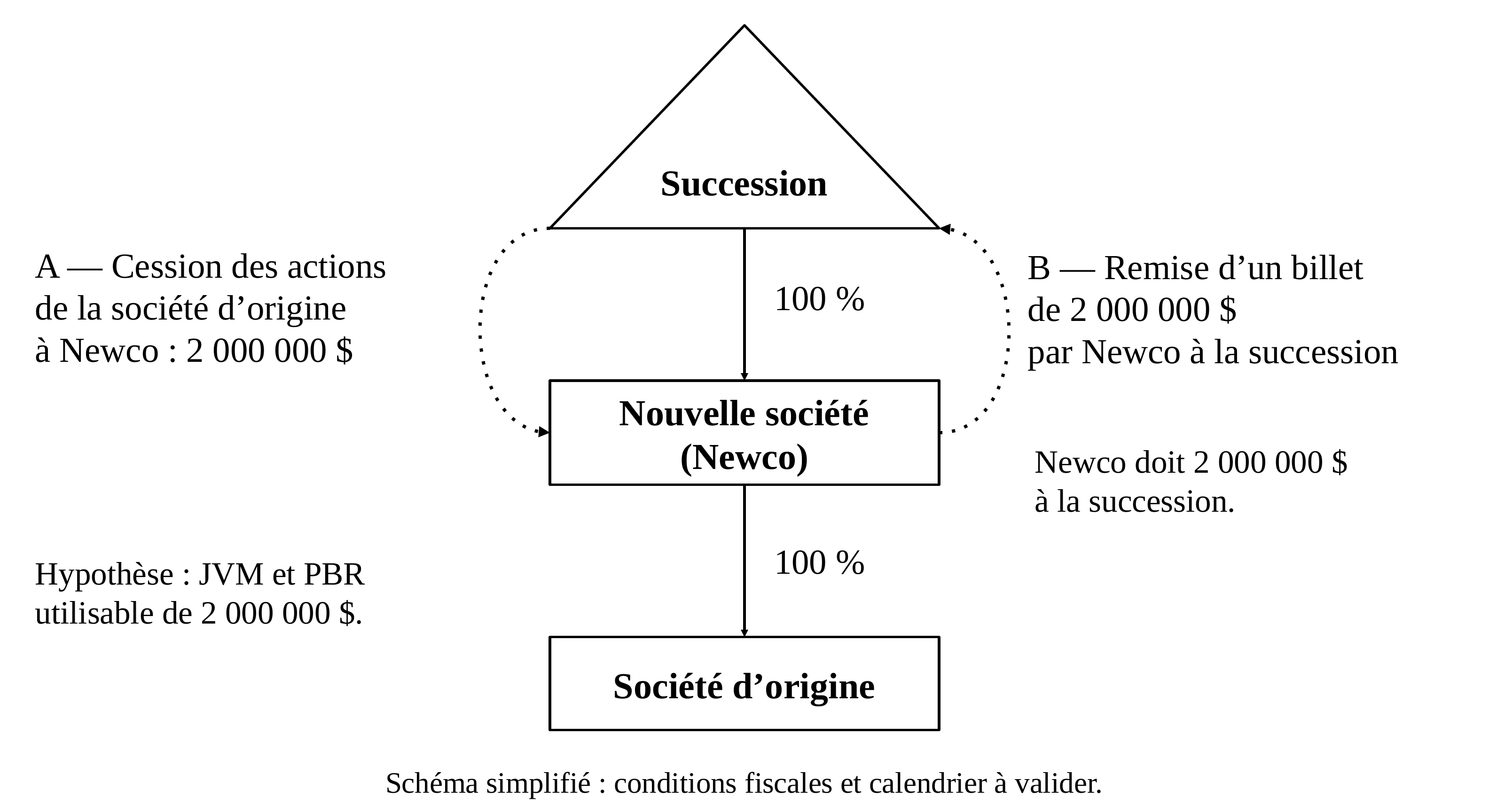
Access to the cash must then be arranged. The second diagram illustrates the intercorporate dividend route: the original corporation transfers funds to the new corporation, which gradually repays the note. The intercorporate dividend deduction, subsection 55(2) and Part IV tax under the ITA must be analyzed. An amalgamation or a winding-up is another possible route, with its own conditions and timeline.
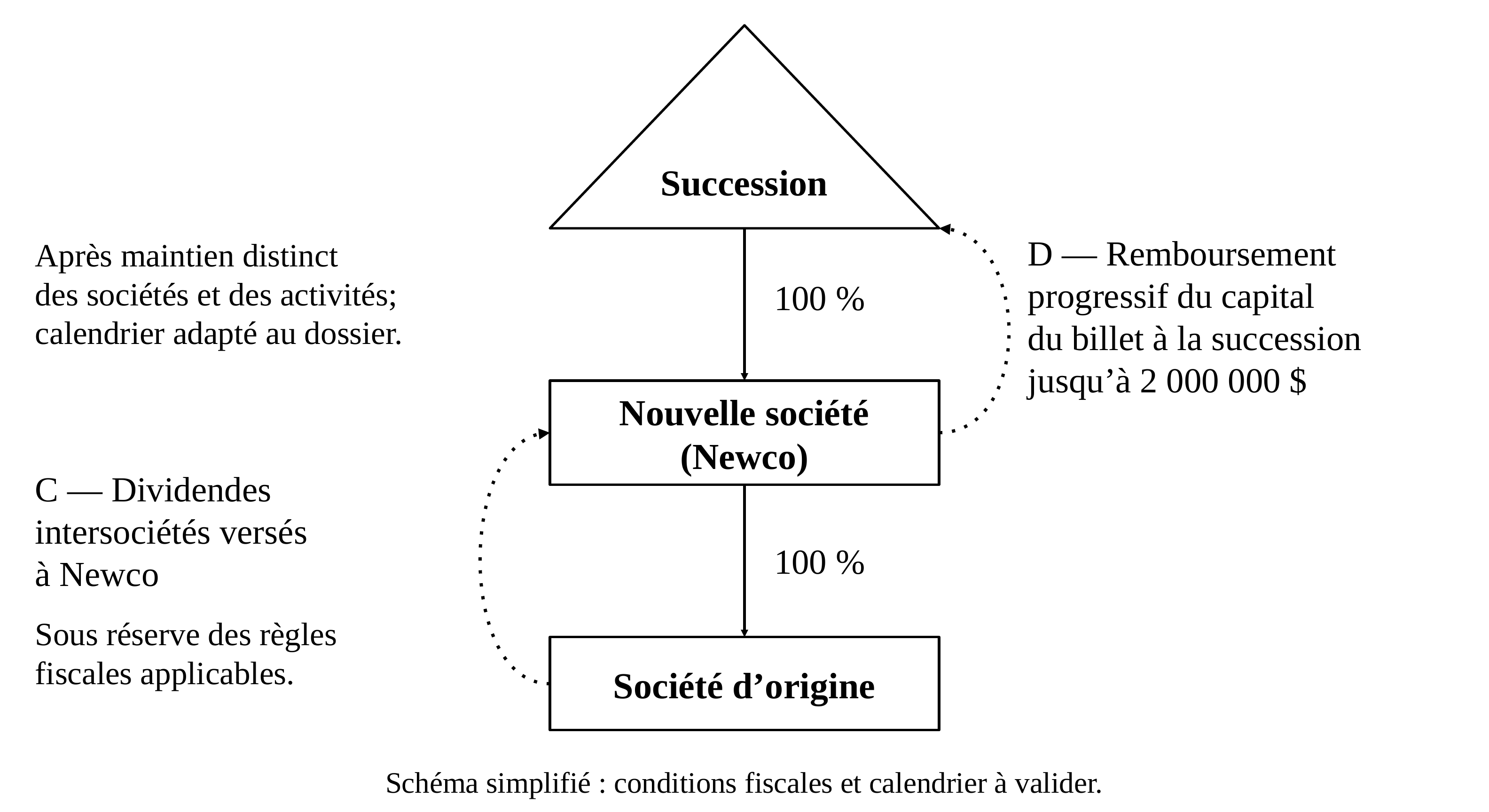
The cash is then used to repay the principal of the note to the estate. Subject to the validity of the overall transactions, this is the payment of a debt. The subsequent distribution to the heirs is a separate estate administration step. The tax on the gain arising on death remains; the pipeline targets the second tax on the value withdrawn. It does not eliminate any tax the corporation may owe on the sale of its own investments or real estate.
Why a promissory note is not enough
Subsection 84(2) of the ITA can recharacterize certain distributions related to the winding-up, discontinuance or reorganization of a business as dividends. For the purposes of section 84.1 of the ITA, the recognized ACB may be lower than the ordinary ACB, particularly where a capital gains deduction was claimed on death or earlier in the history of the shares. The general anti-avoidance rule must also be considered (ITA, section 245).
The CRA assesses these arrangements according to their facts. Favourable rulings have involved keeping the corporations separate and maintaining their activities for a period of time. This is not a statutory waiting period that automatically provides protection. The heirs’ urgent needs and the deadline for paying the tax arising on death may therefore require bridge financing. An advance ruling may be appropriate where the circumstances warrant administrative confirmation.
The other approach: carrying the loss back to the deceased
A redemption may be accompanied by an election allowing an eligible loss to be carried back to the deceased’s final return (ITA, subsection 164(6)). In our example, a fully available loss of $1,999,900 could offset the gain arising on death. However, the dividend received by the estate remains taxable. This method therefore mainly shifts the taxation to the dividend, whereas the pipeline mainly preserves the taxation of the gain arising on death.
Federally, for deaths occurring on or after August 12, 2024, the election may apply to certain losses in the first three taxation years of a graduated rate estate. The extension was enacted in March 2026. Year-ends and election deadlines remain crucial. Québec announced its harmonization in Information Bulletin 2026-3; the legislative implementation and provincial procedures must be confirmed for each file.
A tax advantage that can be substantial
The pipeline can therefore preserve taxation at the capital gains rate, which is significantly lower than the dividend rate. With one-half inclusion, the top combined marginal rate in Québec is approximately 26.65% in 2026 on the entire gain (ITA, paragraph 38(a)). The following comparison isolates this difference for $1 million fully subject to the top rates for 2026.
| Type of income | Top marginal rate | Approximate tax on $1 million |
|---|---|---|
| Capital gain | 26.65% | $267,000 |
| Non-eligible dividend | 48.70% | $487,000 |
| Eligible dividend | 40.11% | $401,000 |
The difference is therefore approximately $220,000 per million compared with a non-eligible dividend. The comparison is a redemption with a loss carryback under subsection 164(6) of the ITA that entirely eliminates the gain arising on death but leaves the dividend taxable. The advantage can therefore be substantial even when both strategies avoid double taxation.
This illustration uses top marginal rates, before fees and the effects of tax attributes: it assumes, in particular, no capital gains deduction, no capital dividend and no refundable tax to recover. The deceased’s and the estate’s actual rates, as well as the year of the dividend, can change the result. Québec has notably announced a reduction in the tax credit for non-eligible dividends starting in 2027.
Compare the outcome for the entire estate and corporate assets
The best solution also depends on the corporation’s tax accounts. A capital dividend may be tax-free but reduce the available loss under subsection 112(3.2) of the ITA. A taxable dividend may trigger a tax refund to the corporation (ITA, section 129). Combining a partial redemption and a pipeline may therefore make better use of these attributes; their interactions must be calculated before the amounts are set.
The liquidator should have three projections prepared: a pipeline, a redemption with a loss carryback and a combination of the two. These should compare the taxes of the deceased, the corporation and the estate, fees, receipt dates and the net amount intended for the heirs. The valuation of the shares and their tax history are the starting point, before any redemption or substantial distribution.
For a deeper discussion: the estate guide
The Guide complet de gestion d’une succession au Québec et au Canada, September 2026 edition, develops this analysis in Chapter 13, “La stratégie du pipeline post mortem”: sequence of transactions (13.1), tax risks (13.2 and 13.3), the heirs’ situation (13.4) and implementation (13.5).
This reading should be supplemented by Chapter 12 on the subsection 164(6) election under the ITA, particularly sections 12.6, 12.8 and 12.11 on losses, the assumption of Québec harmonization and the interaction with the pipeline, and then by Chapter 14, sections 14.2 and 14.4, on hybrid strategies and the capital dividend account. Chapter 10 addresses precautions before distributions to heirs.
Sources and tax details
Main references
ITA, subsections 70(5) and 70(6), section 54 and subsection 84(3) — death, tax cost, dividend and loss on redemption.
ITA, subsections 164(6) and 112(3.2); S.C. 2026, c. 3, section 79 — extension enacted on March 26, 2026, for deaths on or after August 12, 2024.
Québec, Information Bulletin 2026-3, April 29, 2026, p. 4 (tax credit for non-eligible dividends starting in 2027) and pp. 8–9 (announced post-mortem harmonization).
ITA, subsection 84(2), sections 84.1 and 245; CRA, 2026-1089341C6, May 5, 2026 — administrative position reproduced by Tax Interpretations.
ITA, subsections 83(2), 55(2), 112(1), 112(3.2), section 129 and Part IV — capital and intercorporate dividends, losses and tax refunds.
2026 rates: ITA, paragraph 38(a); CRA, T4032-QC (2026); CRA, T5 slip; Revenu Québec, 2026 rates; Guide TP-646.G, dividend tax credit. Calculations after the Québec federal abatement; amounts rounded to the nearest thousand.
- LIR, par. 70(5) et 70(6), art. 54 et par. 84(3) — décès, coût fiscal, dividende et perte au rachat.
- LIR, par. 164(6) et 112(3.2); L.C. 2026, ch. 3, art. 79 — prolongation adoptée le 26 mars 2026, décès depuis le 12 août 2024.
- Québec, Bulletin d’information 2026-3, 29 avril 2026
- LIR, par. 84(2), art. 84.1 et 245; ARC, 2026-1089341C6, 5 mai 2026 — position administrative, reproduite par Tax Interpretations.
- LIR, al. 38a)
- ARC, T4032-QC (2026)
- ARC, feuillet T5
- Revenu Québec, taux 2026
- Guide TP-646.G, crédit pour dividendes
The displayed date is separate from the content review date. This article provides general information based on the stated sources and scope of review. It is not tax advice tailored to your situation. The rules, their conditions and administrative positions must be reviewed before taking action.
APPLY THIS TO YOUR SITUATION
Support for your plans.
Rollovers, holding corporations, amalgamations and wind-ups: organize transactions around your goals and their tax consequences.
Pipelines, loss carrybacks, redemptions and distributions: compare alternatives for an estate holding private corporation shares.