
In this publication
Three key takeaways
- Compare corporate and personal taxes together, taking account of contributions, retirement savings and when you expect to withdraw the money.
- Without Québec’s small business rate, dividends may cost more overall; giving up the federal small business rate warrants comparison.
- In a holding corporation, a taxable dividend may trigger a corporate tax refund that should be compared with its personal tax cost.
Salary, dividends or a combination of both? For an incorporated business owner, the right answer depends on the tax paid by the corporation and the owner, when the money will be used, and the owner’s savings plans. A low corporate tax bill does not guarantee a better result in your pocket.
Business owners have considerable flexibility
Salary is generally deductible for the corporation and taxable to the business owner. A dividend comes from profits that have already been taxed in the corporation; the shareholder then pays personal tax, with a credit to account for that first level of taxation. Both taxes must therefore be added together to compare the options.
In the usual case of a Canadian-controlled private corporation, the Canada Revenue Agency (CRA) generally does not challenge the amount of salary or bonus paid from the profits of ordinary business activities to an active owner-manager who resides in Canada. Revenu Québec recognizes this approach. Business owners therefore have considerable flexibility to choose salary, bonuses or dividends. This flexibility is administrative; the statutory reasonableness requirement remains in force.
When dividends cost more: under-integration
Some small service corporations do not have enough qualifying hours to obtain Québec’s small business deduction (SBD). The full benefit generally requires 5,500 hours. It is reduced between 5,000 and 5,500 hours, and unavailable at 5,000 hours or less. Special rules and exceptions apply.
A corporation that qualifies for the federal SBD but not Québec’s generally pays 20.5% tax on its qualifying business income. The resulting dividend usually remains a non-eligible dividend. The shareholder’s credit then fails to compensate sufficiently for the corporate tax.
Consider $100,000 of additional profit and a Québec business owner who is already taxed at the highest 2026 rate. The corporation pays $20,500 and distributes the remaining $79,500 as a dividend. After personal tax, the owner keeps approximately $40,786. A deductible salary of $100,000 would instead leave $46,695 before contributions. The $5,909 difference illustrates under-integration: using a dividend increases the total tax in this example.
The subsection 89(11) election can narrow this gap
In this situation, the corporation can consider the election under subsection 89(11) of the Income Tax Act (ITA). It gives up the lower federal rate and generally pays 26.5% on this income. In return, subject to its tax accounts, it can pay an eligible dividend, which attracts less personal tax. The corporation pays more, but the business owner may keep more overall.
Here is the result for the same $100,000 of profit:
| Method of compensation | Total taxes | Personal net amount |
|---|---|---|
| Deductible salary | $53,305 | $46,695 |
| Non-eligible dividend Federal SBD only | $59,214 | $40,786 |
| Eligible dividend With the subsection 89(11) ITA election | $55,979 | $44,021 |
Illustration using the highest 2026 rates, excluding contributions and any RRSP impact. It assumes the tax accounts permit an eligible dividend. These are not the results for a person whose total annual income is $100,000.
The election provides approximately $3,235 more than the non-eligible dividend in this example, but still leaves less than salary before contributions. It therefore deserves consideration when profits will be withdrawn soon. If the money remains invested for several years, keeping the lower rate instead leaves $79,500 to grow in the corporation, compared with $73,500 after the election. The withdrawal horizon can therefore change the answer.
Profits accumulated before the election may have to be distributed first as non-eligible dividends. The tax accounts must therefore be checked, and Form T2002 must be filed by the required deadline. Subsection 89(14) ITA concerns the designation of an eligible dividend; it does not replace the election.
Salary can also support retirement saving
Salary generally creates RRSP contribution room for the following year; dividends do not. A salary of $35,000 can therefore generate $6,300 of new contribution room, subject to the applicable limits and adjustments. A targeted salary supplemented by dividends can therefore be useful.
Québec Pension Plan (QPP) contributions have a cost, but can also improve the future pension. A complete comparison must include contributions by both the employer and the business owner, RRSP contribution room and expected retirement income.
Holding corporations: a dividend can trigger a refund
Part of the tax paid by a Canadian-controlled private corporation on its investments is refundable when it pays taxable dividends. This is the dividend refund. A salary does not trigger this refund.
For example, on $10,000 of interest, such a Québec corporation pays approximately $5,017 in tax, of which $3,067 is recoverable. A non-eligible dividend of $8,000 allows it to recover that $3,067 in this example. At the highest 2026 personal tax rate, the shareholder pays approximately $3,896 on the dividend. The additional tax cost of the withdrawal for the corporation and shareholder together is therefore approximately $829: $3,896 less $3,067. The initial tax on the interest has already been paid.
If the personal tax rate on this dividend were instead 30%, the personal tax would be $2,400, less than the $3,067 refund. Withdrawing money may therefore be worthwhile even without a need to spend it, particularly to contribute to a TFSA or repay expensive personal debt. Conversely, waiting may be preferable if the personal tax rate is expected to fall in retirement.
The refundable tax balance and the required type of dividend must be checked. The refund stops once that balance is exhausted, and the corporation must be able to fund the dividend before receiving the refund.
Paying a salary or dividend to a family member
When a salary is paid to a spouse or child, the reasonableness rule must be examined specifically. The family member must perform actual work, and the compensation must reflect the duties, time spent and skills involved. For example, part-time administrative work does not automatically justify an executive salary. A job description and a record of hours make the amount easier to support.
Family dividends raise another issue: the tax on split income (TOSI), under section 120.4 ITA, can subject them to the highest tax rate. Exclusions exist, including for certain adults who are actively involved in the business. Being a spouse or a shareholder is not enough. TOSI generally does not apply to salary, although its deductibility remains tied to the work performed and the reasonableness of the amount.
A decision to revisit every year
The comparison must start with the same personal after-tax cash requirement and measure what remains after tax, both inside and outside the corporation. It must preserve business liquidity, consider TFSAs, RRSPs and personal debts, and plan for future withdrawals. The answer is often a combination of salary and dividends.
The year of withdrawal also matters. Québec has announced a reduction in the credit for non-eligible dividends starting in 2027, which would increase their personal tax cost. The examples use 2026 rates; projections will need to take the status of this measure into account.
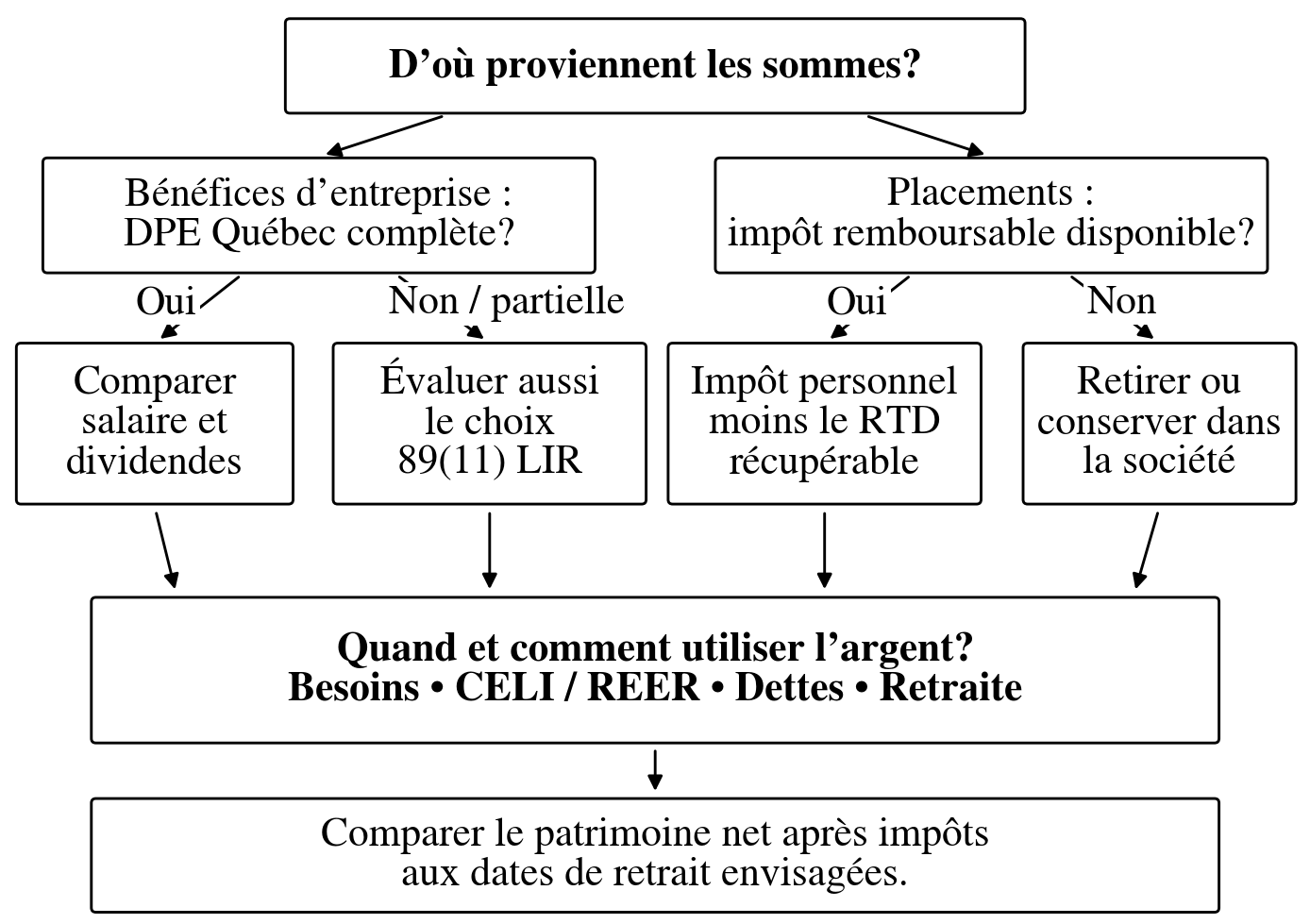
Discussion tree: which comparison should you make?
The following tree helps identify the useful comparisons. Both branches can apply to the same corporation.
Sources and tax details
Key references — checked on September 6, 2026
Salary: paragraph 18(1)(a) and section 67 ITA; section 420 of Québec’s Taxation Act. CRA, Income Tax Technical News No. 22 and No. 30 (archived publications); Revenu Québec, letter 13-019259-001, April 22, 2014. RRSPs: subsection 146(1) ITA.
SBD: section 125 ITA; sections 771.0.2.4 and 771.2.1.2.1 of Québec’s Taxation Act; guide CO-17.G, sections on the SBD. Certain hours worked by a majority shareholder count even without salary; the previous year and special sectors must also be checked.
Election and dividends: subsections 89(1), (8) and (11) to (14) ITA; CRA, election and Form T2002. Filing is due no later than the T2 filing deadline; revocation is subject to restrictions. The election does not eliminate refundable tax on investments.
Dividend refund: sections 123.3, 123.4 and 129 ITA. TOSI: section 120.4 ITA. Personal tax rates used: salary 53.31%, non-eligible dividend 48.70%, eligible dividend 40.11%. Amounts are rounded.
Proposed measure for 2027: Québec Information Bulletin 2026-3, pages 3–4; Bill 6, sections 33–34. Announced reduction of the credit from 3.42% to 2.69% of the grossed-up amount; assent was not recorded in the legislative progress information consulted.
The displayed date is separate from the content review date. This article provides general information based on the stated sources and scope of review. It is not tax advice tailored to your situation. The rules, their conditions and administrative positions must be reviewed before taking action.
APPLY THIS TO YOUR SITUATION
Support for your plans.
Salary, dividends, major withdrawals or retirement: coordinate your corporation’s taxes with your personal needs.
Remuneration, dividends, tax accounts and upcoming plans: a periodic review to make timely decisions and coordinate their implementation.